The Origins of Emotional Koans
Jun Po Roshi received Inka from Eido Shimano in the Rinzai lineage. This lineage, as it landed in 21st-century America, was essentially a formulation of Hakuin Ekaku, who lived in the early 18th century. In Hakuin’s system, koans were offered in a structured curriculum. He taught that kensho, awakening, is the beginning of the journey rather than a final arrival. To truly understand the terrain of awakening, students are guided through a series of mental directives in dialogue with an awakened teacher. These are koans.
The koans themselves are often teaching stories from the Chan (Chinese Buddhist) tradition, which later became Zen in Japan and the United States. Chan flourished between the 6th and 13th centuries, producing writings and stories of patriarchs and teachers. These encounters were preserved in classic koan collections, most notably:
The Gateless Gate (Mumonkan), compiled by Wumen Huikai
The Blue Cliff Record, compiled by Xuedou Chongxian and Yuanwu Keqin
The Book of Serenity, compiled by Hongzhi Zhengjue and Wansong Xingxiu
Formulated in the 12th and 13th centuries, these texts became foundational to Rinzai koan training. In our lineage, The Blue Cliff Record and The Gateless Gate form the essential core of the curriculum.
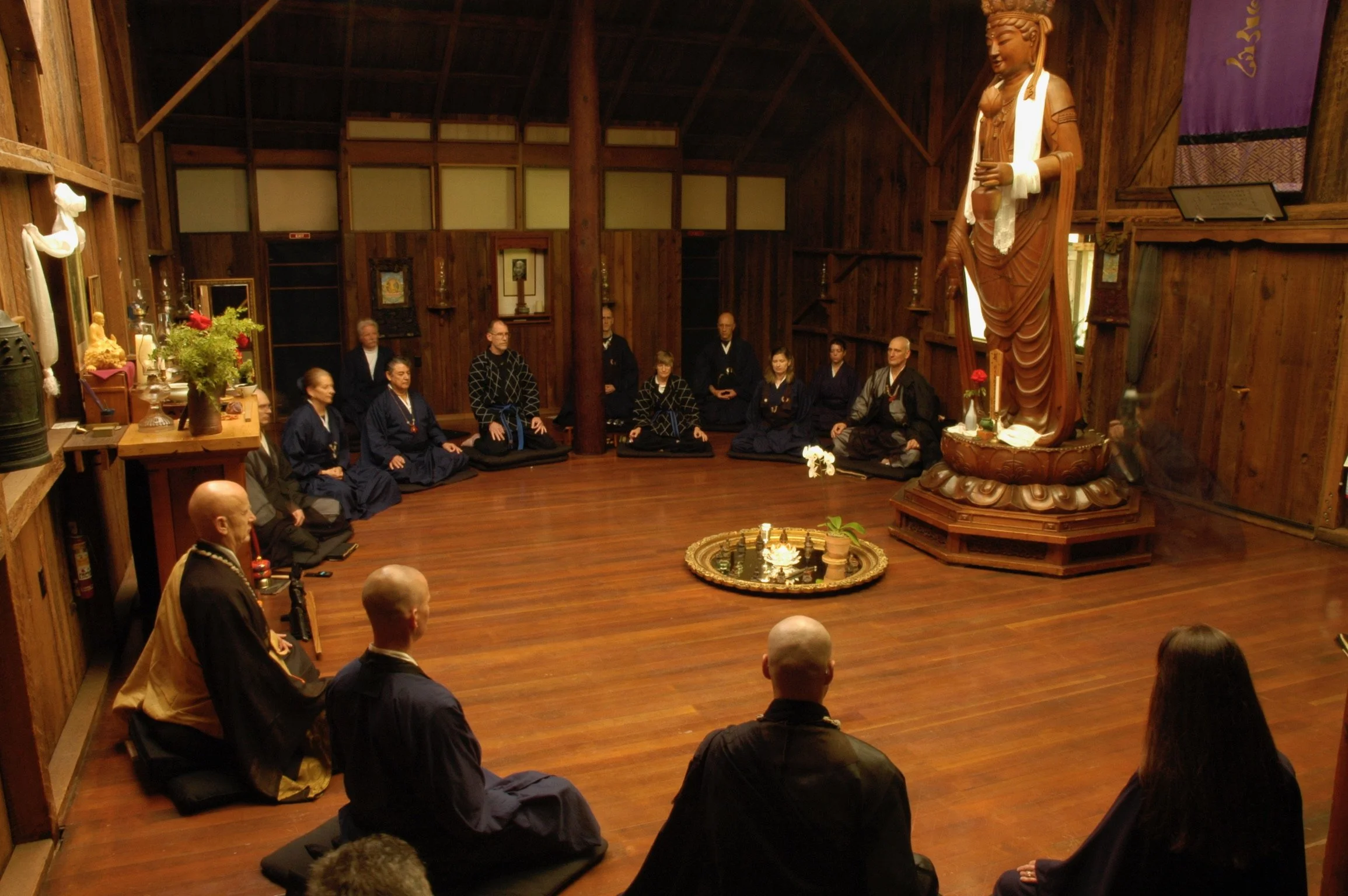
Jun Po Denis Kelly Roshi spent many years at Dai Bosatsu Zendo Kongo-ji, working through koans with Eido Shimano Roshi. The training unfolded primarily within sesshin (intensive eight-day retreats) and kessei (90-day practice periods). During these extended periods of practice, the koan was given in private interviews known as dokusan. The koan became the focal point of meditation, eventually extending beyond the cushion into work, meals, and daily activity.
In dokusan, the student presents their understanding or embodied experience of the koan. If the teacher is satisfied, the student “passes” and receives the next koan. If not, they are sent back for further inquiry. Teachers may pose “checking questions” to refine and deepen insight. The intention is not intellectual comprehension, but embodied awakened awareness.
Koan Practice in Context
Koan inquiry is a profound and transformative process. However, it is not the only form of Buddhist or Zen practice. In contrast, the Soto school emphasizes shikantaza, “just sitting”, a practice of wholehearted presence with what arises. While Soto teachers may reference koans as teaching stories or “public cases,” they are not generally used as a progressive meditative curriculum.
Many forms of Buddhism do not use koans at all. Yet for Jun Po Roshi and our Rinzai lineage, koan practice is essential. Jun Po employed koans both as meditative inquiry and as living teaching vehicles.
Awakening and Growing Up
As a Mahayana path, Zen aims at the awakening of all beings, moving beyond ego and recognizing the universal nature of consciousness. One might assume that awakening naturally produces kindness and compassion. However, Jun Po Roshi’s experience as head student, and later vice-abbot, revealed something more complex.
He distinguished between awakening (kensho) and what he called growing up. This distinction resonates strongly with the integral theory of Ken Wilber. Awakening may reveal the non-dual nature of reality, yet psychological and emotional maturity does not automatically follow. Growing up involves learning to live compassionately and responsibly with others.
Jun Po observed that traditional monastery practice did not sufficiently address emotional development. While compassion is central to Zen teaching, it did not always translate into embodied emotional intelligence.
Emotions and the Evolution of Consciousness
Traditionally, Buddhist texts use the term feeling (vedana) to describe basic attraction, aversion, or neutrality toward stimuli—not what modern psychology calls emotions. Emotions, as we understand them today, involve complex narratives layered upon primary feeling tones.
A review of classical koan literature reveals almost no explicit attention to emotional life. This absence makes sense when viewed historically. Western understandings of emotion were shaped significantly by figures like William James and Sigmund Freud to name just a few. Cultural interpretations of emotion have evolved dramatically. Even the modern notion of romantic love is a relatively recent Western development.
More recently, neuroscientist Lisa Feldman Barrett proposed the theory of constructed emotion, suggesting that emotions are not universal biological givens but socially and culturally constructed. While basic affective processes exist, emotions themselves are shaped by learned concepts and context.
This view parallels the Buddha’s teaching of dependent origination: everything arises in relationship and through conditions. What we feel, think, and believe is conditioned—and therefore transformable.
Jun Po Roshi referred to emotional reactivity as the “hysterical historical”—our present reactions shaped by past conditioning. Though he was not explicitly drawing on contemporary neuroscience, his Mondo Zen Facilitation practice aligns closely with this constructed view of emotional life.
The Emergence of Emotional Koans
With the capacity to witness the mind through meditation and koan practice oriented toward awakening, Jun Po extended inquiry into the emotional domain. Rather than abandoning classical koans, he added a new category: emotional koans.
Traditional koans often test or deepen realization of non-dual awareness. Emotional koans, by contrast, examine the relative world—how feelings and behaviors manifest in lived experience. They assume that the practitioner has already tasted kensho, which Jun Po described as Pure Awareness or Clear Deep Heart-Mind.
Mondo Zen Facilitation begins with nine koans that stabilize this recognition. As in Hakuin’s curriculum, awakening is only the beginning. Koans nine through thirteen apply awakened awareness to daily life.
The tenth koan asks:
“What feelings arise when you actually experience this insight and understanding?”
This question looks nothing like a classical koan from The Gateless Gate or The Blue Cliff Record. Rather than pointing beyond the ego, it turns toward it. It invites inquiry into the emotional response that accompanies awakening. Kensho may feel blissful, joyful, peaceful, or neutral. What matters is recognizing and expressing the felt sense arising within Pure Awareness.
Just as in traditional dokusan, the facilitator acknowledges the student’s expression—completing the Mondo exchange. The subsequent emotional koans continue this descent into embodied life, integrating awakened awareness with emotional conditioning.
Continuing the Evolution of Dharma
The Rinzai koan system evolved over more than a millennium. Throughout most of that history, emotional life remained largely unexamined within formal koan curricula. Jun Po Roshi, thoroughly trained in Hakuin’s system, did what Zen masters have always done: he evolved the dharma to meet the needs of his time.
Emotional koans extend post-awakening training into the psychological and relational sphere. Rather than transcending the ego, they invite practitioners to embody awakened awareness within the ego’s emotional patterns.
In doing so, Jun Po Roshi continues the spirit of Hakuin’s insight: awakening is the beginning, not the end.
In the next blog, we will explore the remaining emotional koans in greater depth and examine how they function in lived practice.
For more on Jun Po Roshi’s Koans see: