Daiden Dan Pecaut Roshi
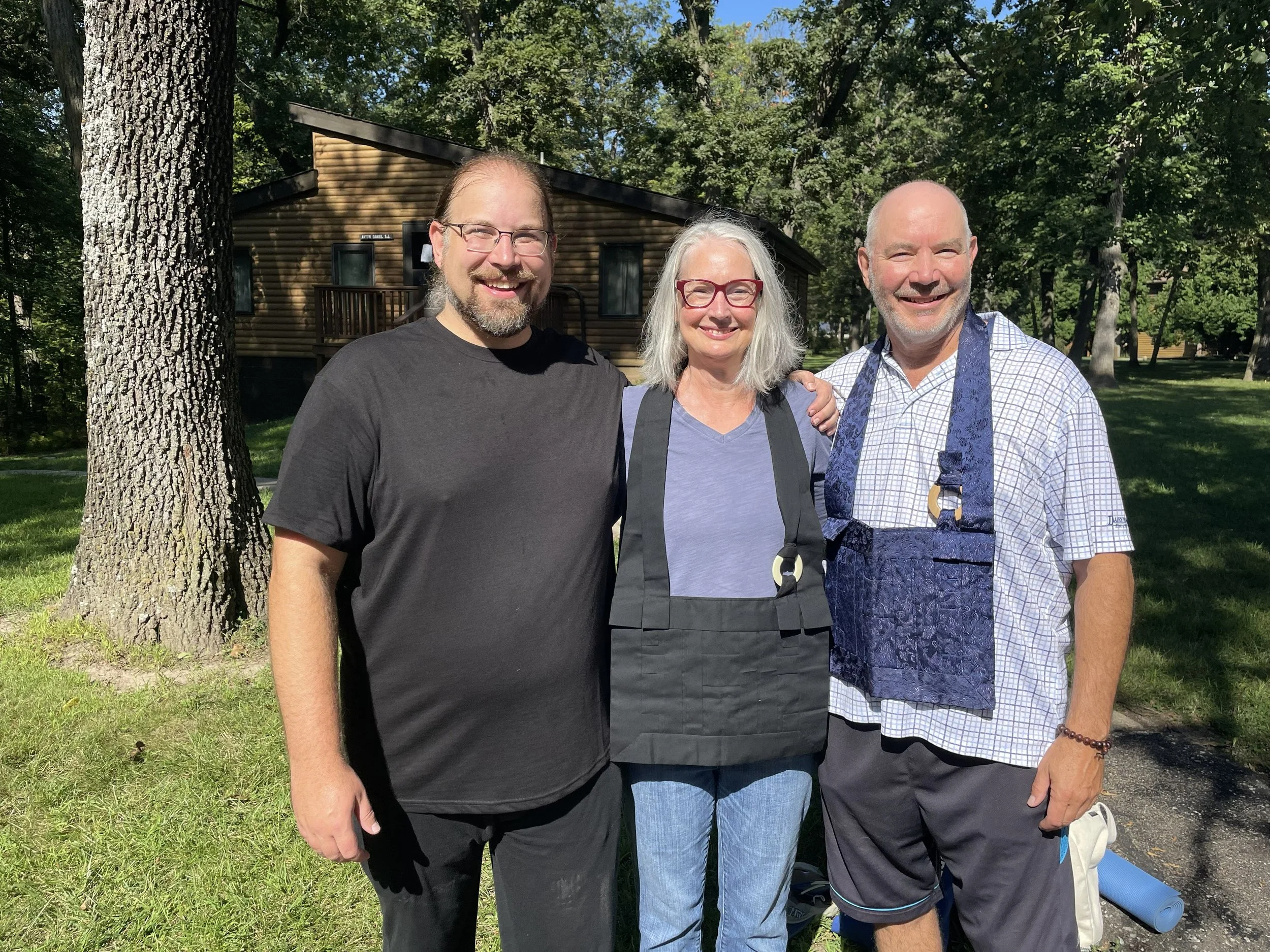
Daiden Roshi first sat with me at Hollow Bones Zen Sesshin at Sonoma Mountain Zen Center in 2020. As he made fun of me during the closing festivities, I knew we would sit together again. I recently returned from his inka ceremony in this past August. He and I are now dharma brothers in the 85th generation of the Rinzai Zen lineage. Daiden Roshi founded and directs Siouxland Zen in Sioux Falls Iowa. He is author of several books including Beating Bronchiectasis, University of Berkshire Hathaway, and Letters To Siouxland Zen. I caught up with Daiden a few weeks after his inka ceremony. He was still quit excited by the whole adventure.
Ekai: Daiden Roshi is the founder of Siouxland Zen, and a student of Junpo Roshi. Recently, he received transmission from Fugen Roshi. He and I are now brothers in the 85th generation of the Rinzai Zen Lineage.
Daiden: We're aligned.
Ekai: Let’s go back to how you learned to meditate.
Daiden: I had heard about meditation and I'd read about Zen, but I never really acted on it until 2008, when an MKP warrior brother Jerry Hawk said he met this guy named Junpo. So eight of us jumped in our cars and drove up to Green Bay for Rohatsu in December. It was wild. I had never meditated more than 15 minutes, and suddenly I'm meditating 10 hours a day! My knees hurt, my back hurt, and my neck hurt. But Junpo promised us, "If you stick with it, by day four or five, you'll know what we're talking about.” I did. That hooked me right there.
Ekai: Good for you. Then you started attending Hollow Bones retreats regularly?
Daiden: Yeah, I tried to do a couple a year, but I knew right away I would want a local sangha to sit with. So I asked Junpo. He said, "If you build it, I will come.” So we started sitting once a week here in Sioux City, and at the same time we prepared for a retreat in the summer of 2009. We had no idea what we were doing. I just so loved Junpo’s willingness to just jump right in. No one knew what the form was or what the procedures were. It was chaos. We've been sitting every year at the Creighton University Retreat Center in southwestern Iowa since 2009. It's a beautiful site. I’m thankful to have that place.
Ekai: You took Jukai with Jun Po Roshi in 2012, and then you were ordained as a priest in 2014. Was there some motivation to become a priest?
Daiden: Not really. I just was in the stream and letting it take me along. When I actually got ordained there was a part of my mind saying, "What are you doing? You have no preparation. Junpo is just throwing you in the deep end.” And another part of my brain just loved it. Like “this is Zen. Trust the not knowing, and trust the teacher,” and off we went. It's been a wonderful experience.
Ekai: Then with Siouxland Zen, you started to really get people to know what they're doing.
Daiden: That's right. I've always had compassion for our students and fellow meditators. I trust the bell. We sit. I trust the silence. We're clean and clear about that. I think the rest takes care of itself.
Ekai: What do you love about the practice?
Daiden: The bell. At my first seven day retreat with Junpo fall of 2009, with my first Dokasan with the master. I was trembling because Junpo had an imposing physique. He was about six foot two and angular, and when I came in to the Dokasan room, he rang his singing bowl. It just blew me away. I'd never heard a singing bowl like that before, so I blubbered something like, "Wow, that bowl's amazing,” He just shoved it over to me. I said, "So you want me to ring it? “He goes, "No, I want you to take it.” I was just totally touched by his spontaneous generosity. That moved me deeply and has always been a part of the practice for me. The bell transmits.
Ekai: The bell is very important to Mondo Facilitation. People take it for granted. They pay attention to words, but the bell essential.
Daiden: Bell is the trainer.
Ekai: You're trained in Mondo Zen Facilitation, but you've taken it in your own direction. Tell me a about how you see Mondo Zen and emotional koan work.
Daiden: The first set of koans are just brilliant. I've worked with easily over 1000 people. People get a taste of this deepest truth of who we are. It's really extraordinary, and they come in different ways. Sometimes it's the listening koan. Sometimes it's an embodiment koan. Sometimes it's some other element like the pointers, the words that point to this pure selfless awareness. But wherever it happens, we just stop and sit in it. You know that recognition, so beautiful.
The emotional koans? I really saw Junpo as a pioneer. He was starting something new. It's really on us to evolve it, to make it more efficient or more effective, taking people to deeper healing. So in my case, what I found is once people have the platform, then all kinds of work can happen. The most important part of the emotional koans begins with “has anyone ever made you angry, shamed you, or caused you to disconnect.” To me, the entire practice hinges on this koan. Once people say no, and feel it, and come home to this truth that it's 100% on their plate, that's the hinge on which the whole practice moves. Before that moment, they're stuck. They're still blinded by their own ego projections on the world.
Ekai: Right.
Daiden: The idea that emotional activity is really energy. It's information. There's gold in there, so sit with it long enough and find the gold. And with that, I found zazen. One of its virtues is that it builds the capacity to sit with intensity. Took me years to really get that. So the deeper my zazen practice, the more intensity I can sit with, and that enables me to do deeper work, work that might not really be accessible when I start out. This in turn allows me to sit and hold space for others to do their work.
The other huge gift from Junpo is to see that all reactivity rises from deep caring. That's the shortcut, right? So I'm very reactive. Well, what is it I care so deeply about here? And that always drops me into my heart. And then there's clarity and compassion, and the whole deeply conditioned reactive program can be kind of unplugged.
Ekai: Lovely. I appreciate the way you got the heart of Junpo's innovation in his teaching. What I hear is that we're shifting it back to compassion practice versus bypassing, which is when we get preoccupied with too much koan work.
Daiden: It's completely flipping the orientation. We're turning in to what's right here.
Ekai: Right.
Daiden: But the other thing that's evolved for me beyond that is finding that when people have reactivity, it can be incredibly effective and efficient to identify the trigger. I'll just use myself as an example. When my father would get angry and I was a little boy, he might say, "You idiot! You know, you're so frustrated.” As a little boy, that penetrated me, and I would just sort of collapse. Now as an adult, if my wife happened to say that it can be very irritating. I was surprised when as an adult I had the same reaction. I was that little boy again. I was just collapsing, and I felt very defensive. I wanted to hide. I wanted to protect, and it's like okay. This is an intense reactive pattern for me to sit with. And what I found was if I just sit with the embodied reactive experience, just forget all the story, forget the word itself. So I say, you idiot! Look at my shoulders are collapsing. My gut is churning. My jaw is tightening. Just notice the raw sensations of the reaction. Not in the story. I'm in the present moment with this body sensation, and then just sit with it for maybe two or three minutes. It's not comfortable, but I'm not dying. That's such a deep understanding. I'm not my reactivity. I'm the space in which it arises, and if my practice is deep enough, it dissipates itself, right? Then something else can open, and I call that insight. In my own case, I just wept and wept. I can feel it right now. My father's love for me. What I realized underneath that “you idiot’, with his deep desire for his son to be a competent, appropriate, mature human being. And if I make mistakes, that look pretty dumb to him. That needs to be called out. Now, maybe it wasn't the most elegant way to do it. But it was love. It wasn't a phrase he would use with other people. It was reserved for someone he loved the most, and he could not allow me to evolve in a way that would allow these kind of mistakes to happen.
Ekai: I appreciate in that story you're seeing the reciprocity of the teachings. It's not just in me. It's in the relatedness. The insight is relational.
Daiden: That's right. Which is being an interior experience of my own ego development.
Ekai: Yes.
Daiden: Contained there as a wound or hurt or a shadow or a trauma or whatever you want to label and it's opened up into a bigger view. A bigger context that can hold all of it, seeing the relationship in it, or the energy in it, or the wisdom in it, deliberating it, or perhaps integrating it, depending what needs to happen.
Ekai: But being able to see it as compassionately arising as the wisdom of the universe.
Daiden: Well put. Passionately arising as the wisdom of the universe.
Ekai: I think this is a wonderful extension of Junpo's teachings. The Rinzai structure puts the relational into dokasan where the primary relational work is done, this made sense in in feudal Japan, but now in 21st century we're not in that sort of rigid hierarchical structure. This teaching shows us was one of Jump's big concern, can you show up in relation to who's going to call you, your wife, your kid, whoever. That's where the work is. That's the dokasan room now.
Daiden: I was curious to see how this would work with my students, and it was incredibly profound. Just realizing the trigger words or event, and then setting it aside, and then going into zazen, meditative mind, and then re-encountering the trigger from this deeper mind, allowing it to arise as a contraction in the body. So we're not in the story; we're in the now, and allowing it to release, and then see what's there, and it's been amazing.
Ekai: It's interesting because our timing sequence is slightly different, but it's the same idea of the Rinzai form which asks to spontaneously respond from awakened awareness, right? What we're saying now is, take your time, slow down, allow yourself to be with what's arising, and allow insight to arise at its own tempo, versus I have to do it instantly. Pretty much all the Chan encounter dialogs and the koans orient toward these sudden response. That's the bias of traditional Rinzai, which is less true with Soto forms.
So back to the chronology. Then Fugen Roshi shows up, and he's in the business of passing on the lineage. I received Inka last year, and you received Inka this year. We were both in each other's ceremonies, what was that like for you?
Daiden: It was tremendous. I was looking for a mentor the summer of 2025, and I reached out to Fugen Roshi. I knew him as Tom Pitner in the Mankind Project as a leader. I didn't really know him very well, and so we had a nice hour-long chat, and at the end he says, "Well, I think you're ready to be a roshi. I'm like, what? We didn't say anything about that in the hour chat. And so, I spent about six months sort of in denial and disbelief, just holding the possibility lightly, and then in January I was really struggling with something, so I called Fugen for some mentoring. He just cut through the fog and said, "Be the Roshi you already are.” That's another one of those moments of just a mallet in the head, and instantly I knew what that meant, and it solved. This cloud of confusion evaporated, and that became my new mantra: be the roshi you already are.
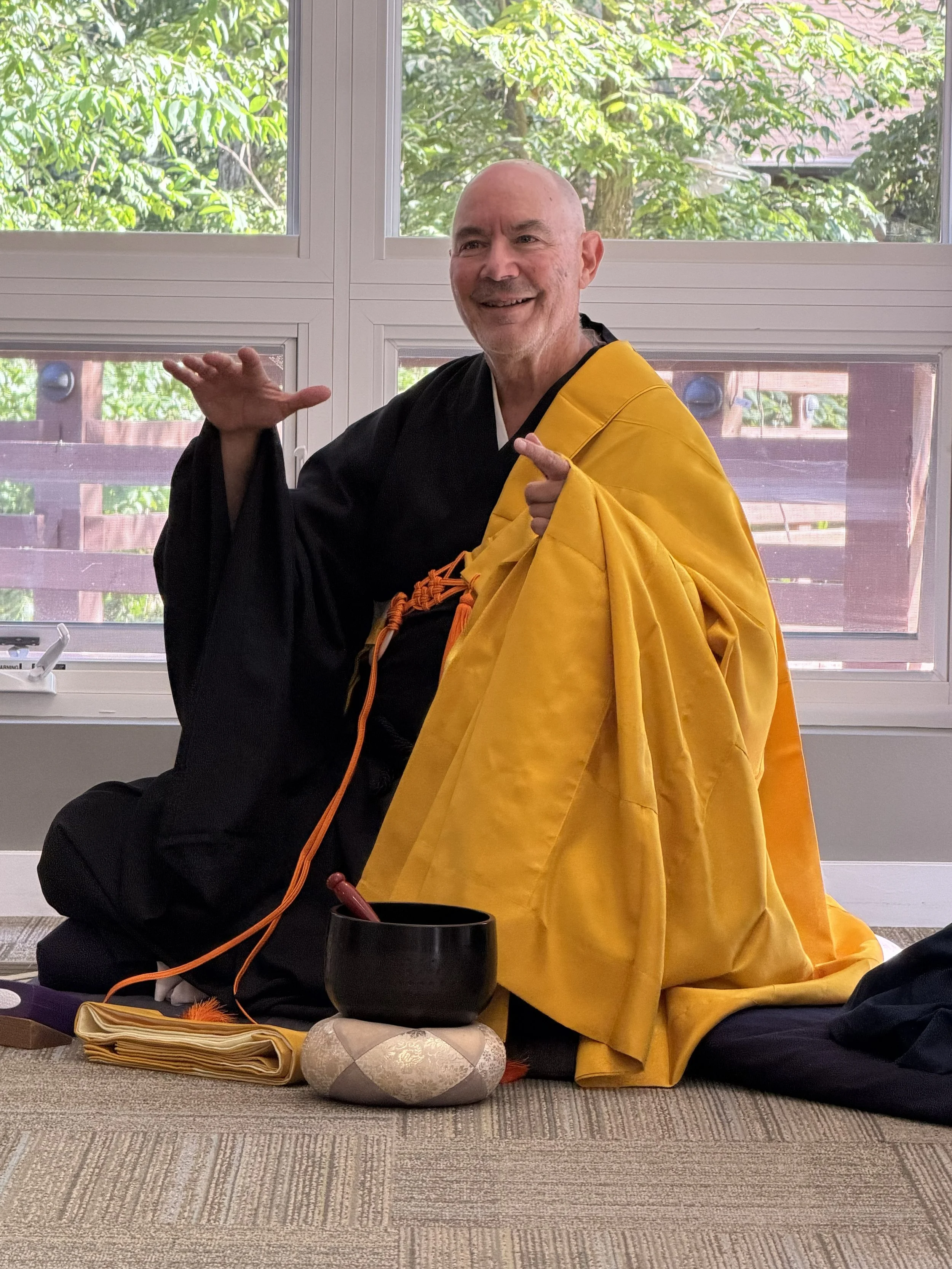
I just started to settle into it. By the time the Inca ceremony came around, it wasn't like something new was going to be put on me. It was just affirming what's already here in a beautiful way. But it was a transmission. The ceremony was very powerful.
Ekai: Nice. It's just natural. You were ready.
Daiden: The one thing that I wasn't ready that I didn't know till I got to the retreat was my ability to keep my heart open and be loved. I'm pretty good at loving others, but allowing others to love me is kind of tricky, and here we are on retreat. 21 participants, and then you, Hosho and Ming Po show up, and my family and my sisters show up. Keeping my heart open and just allowing all that love and support in was a challenge. Because of sitting at it all week, I was able to do that, and that felt wonderful. That pushed me to a level of open heartedness and receiving that I've not felt before. Really beautiful.
Ekai: Lovely. You got through Inca, anything changed back in the sangha? Anything different happening?
Daiden: One of the nicest things to me was just how excited everybody else got!
Ekai: Nice. What do you see on the horizon next?
Daiden: Well, that's the funny thing with this. I really thought I'm going to write more books because I've written two, and I have a lot more books in me. I like to write. I like the process of writing and sharing the practice through that way. But right now, this ordinariness just sort of settled in. Like, there's really nothing to do, no one to be, nowhere to go. To try to make something happen would be forcing things. It's really because I've been so driven, particularly my professional life. I built a multi-million-dollar investment business that carried me a long way. But at the root, there's this ease with the world, right? This drive, and right now it's just not there. So I'm in a mood of not forcing anything and just allowing things to be.
Ekai: That's good. In the in the traditional koan curriculum, when you were done, you went off to do nothing. They called it the Sacred Fetus, where you were in a period of just being ordinary. It's just go be ordinary, just show up, and that, in a way, was sort of a digestion. You go into a completely passive wandering and allow the universe to organize itself in you in some way or another.
Daiden: I think that's what's happening here. I do get thrilled by the moment we're all sharing. In the evolution of human history and the practice. The availability of spiritual wisdom through the internet, through translations, through globalization, is unlike anything we've ever seen. We're so blessed to have a form and a lineage that's proven into which we can pour things like you've done with psychology and other practices. It's a side that can hold this practice.
Ekai: Nice.
Daiden: It's an extraordinary thing,
Ekai: I hear a lot of gratitude, recognizing that the potential for transformation is particularly high and particularly available to us. I’m glad we're doing this together. I'm grateful for your wisdom, and I appreciate you taking the time.
Daiden: Yeah, thank you, Ekai. I appreciate you.