Buddhist Matriarchs of the 20th Century
I’ve been investigating and sharing my Rinzai lineage in several blogs. Noticeably, there are no women. While I cannot change the past, I have been looking into the role of women in the 25 centuries of Buddhist teachings. This led me to find and add to our evening service the “Hymn to the Perfection of Wisdom of Our Great Matriarchs.” This blog will share brief stories of women we honor in our evening service. Part one will look at the 20th-century matriarchs, beginning with the recent passing of Joanna Macy. You can download the entire chant here.

Joanna Macy
Joanna Macy (1929 – 2025) passed away last year. Macy brought together a scholarly understanding of deep ecology, systems science, anti-nuclear activism and Buddhist teachings. She was a co-author of Thinking Like a Mountain: Towards a Council of All Beings with John Seed, Pat Fleming, Arne Naess and Dailan Pugh. Her own text, World as Lover, World As Self, is a seminal work in ecodharmic teachings. Her Buddhist training was in the tradition of Nyanaponika Thera, a Sri Lankan Theravada teacher.

Daju Suzanne Friedman (1969 - 2014) was a doctor of Chinese medicine and Qi Gong master. Daju edited The Junpo Roku: The Dharma & Recorded Sayings of Junpo Denis Kelly. She founded the Robe & Bowl sangha in San Francisco.
Sandra Jishu Angyo Holmes (1941-1998) co-founded the Zen Peacemakers Order with her husband Roshi Bernie Glassman. She was the second abbot of the Zen Community of New York and co-founded the Interfaith Peacemaker Community.
Gesshin Myoko Prabhasa Dharma Cheney (1931-1999) was a student of Joshu Sasaki Roshi. She became an Osho in 1972 and served as director and vice abbess of the Mt. Baldy and Cimarron Zen Centers in southern California. She received Dharma Transmission from Vietnamese Zen Master Thich Man Giac in the lineage of Vietnamese Rinzai Zen.
"You all know that I come from the Zen Buddhist tradition. But when we enter on a spiritual path, and we follow it all the way to its origin, to the root of things, then we all arrive at the same source: the source of everything. That is the way of Zen. Zen just means meditation, but it is a particular way of meditation. It is the way to find the realm of consciousness in which things are not yet divided into past, present and future. When we realize that, it liberates us from the notion that we have to do something to get there or get it.
- Gesshin Myoko Prabhasa Dharma
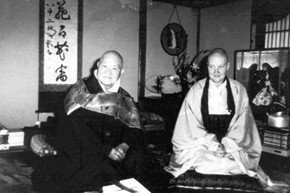
Keido Chisan Koho Zenji and Houn Jiyu-Kennett
Houn Jiyu-Kennett (1924-1996) established the Shasta Abbey monastery in northern California in 1970, where she served as abbess until her death in 1996. She was the first western woman to train at Soji-ji, one of the head Soto temples in Japan. Jiyu-Kennett Roshi received inka from Rev. Keido Chisan Koho Zenji, chief abbot at Soji-ji. Her teachings are available here.
Maurine Myo-on Stuart (1922 - 1990) was a student of Yasutani Roshi and Soen Nakagawa Roshi. After her ordination by Eido Shimano at Dai-Bosatsu, she led the Cambridge Buddhist Association. She received inka from Soen Nakagawa. Her teachings can be found in Subtle Sound: The Zen Teachings of Maurine Stuart.
Baiho Sesshin Trudy Dixon (1939 - 1969) was an early student of Shunryu Suzuki Roshi. She transcribed and edited his classic book of talks, Zen Mind Beginner’s Mind.
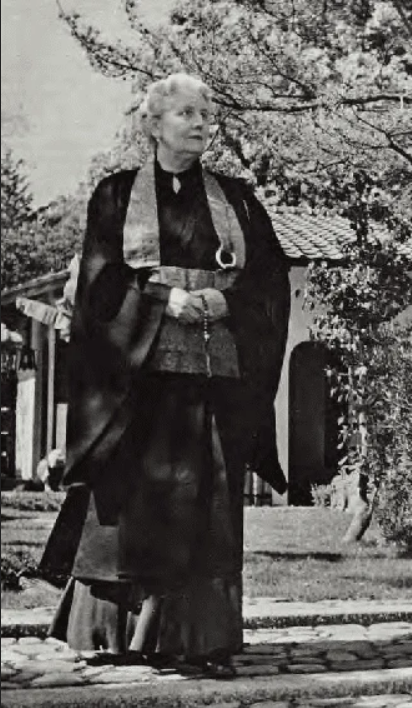
Ruth Fuller Sasaki
Ruth Fuller Sasaki (1893-1967) was the first westerner to train in Japan. She worked as a translator bringing some of the first Zen books into English, including Zen Dust and The Recorded Sayings of Layman P’ang. She eventually married Sokei-an Sasaki, a Rinzai teacher in the United States. She returned to Japan after her husband’s passing and restored Ryosen-an, a sub temple at Daitoku-ji, which became the First Zen Institute of America. She was the first American priest at Daitoku-ji, a leading Rinzai monastery.
Kasai Joshin (1914-1985) was a disciple of Yoshida Eshun and Kodo Sawaki Roshi. She was key in passing on sewing of nyoho-e, robes and o-kesa to Suzuki Roshi’s students.
Yoshida Eshun (1907-1982) taught the craft of nyoho-e sewing in the US in the early 1970s. Some of her most notable students were Tomoe Katigiri and Zenkei Blanche Hartman. She was the abbess of Kaizen-ji Temple in Nagoya, Japan. Learn more about nyoho-e.
Taniguchi Setsudo (1901-1986) devoted her life as a Soto nun to running an orphanage, Lumbini-en, guided by Dogen’s four bodhisattva methods: generosity, kind speech, beneficial activity and cooperation.
Kojima Kendo (1898-1995) was a lifelong activist nun. She was the first leader of the Soto-shu Nuns’ Organization, which was supported in part by Koho Keido Chisan Zenji when he was abbot of Soji-ji. Kendo worked tirelessly to gain equality for female monastics. Some of her demands, such as allowing women to teach independently again, were finally achieved by the end of her life. She was part of several international Buddhist organizations representing the interests of women throughout the Buddhist world.
Nogami Senryo (1883-1980) practiced Zadatsu Ryubo - die sitting, die standing – following Dogen’s instruction to do all activities with complete presence and attention. She died standing in front of the Buddha image in the worship hall at age 97.
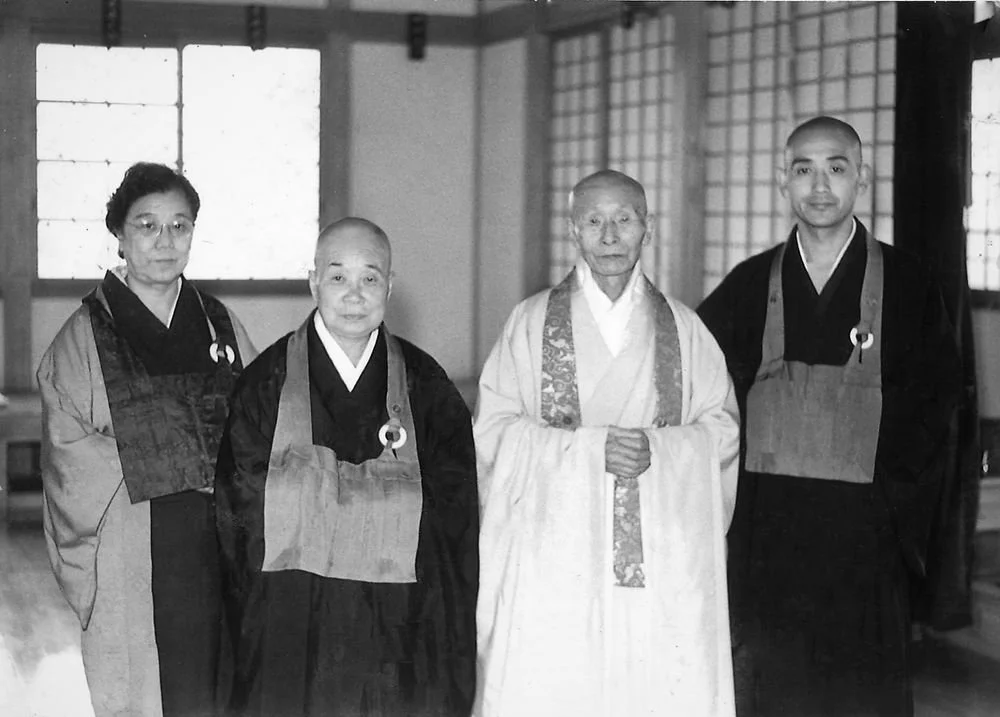
Shiroyama Chisen, Nagasawa Sozen Roshi, Harada Sogaku Roshi and Harada Tangen Roshi
Nagasawa Sozen (1880-1956) was a disciple of Harada Sogaku, becoming part of his Soto lineage with considerable Rinzai influence. She was the abbess of one of Tokyo’s most important convents, Kannonji, and was renowned for keeping women’s practice alive during the Second World War. Her work is published under the title In This Body, In This Lifetime.
Mizuno Jorin (1848-1927), Hori Mitsujo (1868-1927), Ando Dokai (1874-1915) and Yamaguchi Kokan (1875-1933) established the Aichi-ken Soto-shu Niso Gakurin in 1903, nine months after the Soto-shu regulations prohibiting women’s education facilities were lifted. They were key figures in re-opening Soto Zen to women after centuries of increasing limitations. All four spent their entire adult lives striving to create monasteries for women at a time of tremendous political and social upheaval.